
Satellites are electronic structures, consisting of a wide variety of measuring and imaging devices, that orbits around a planet.
First artificial satellite was Sputnik 1 launched on October 4, 1957, by the Soviet Union.
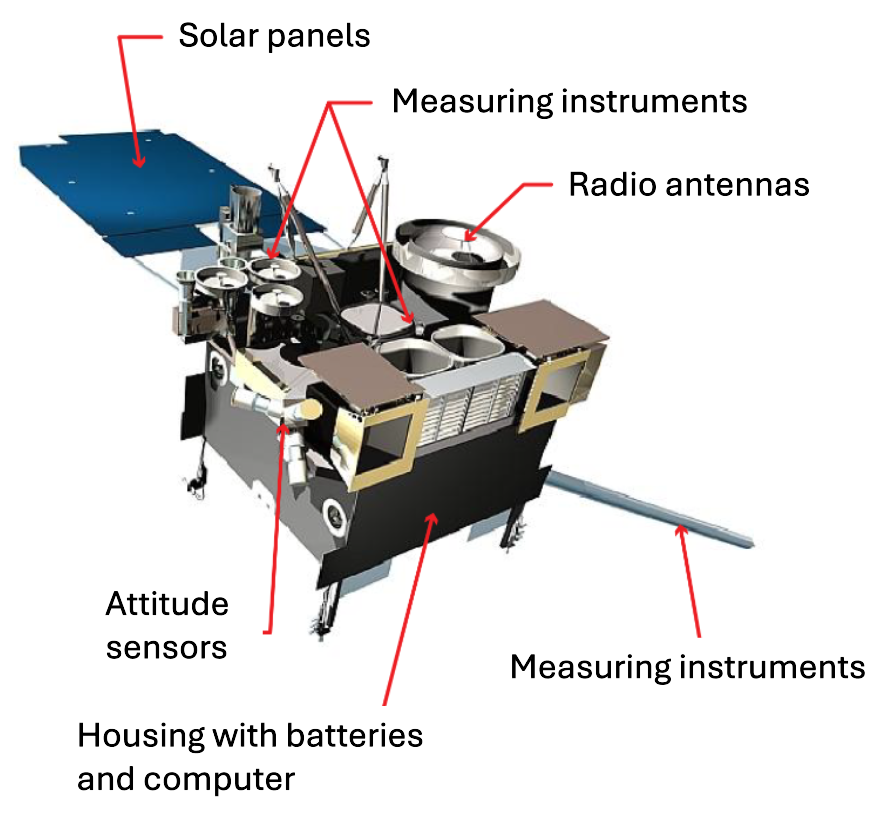
Anatomy of a Satellite
- Payload to collect information (such as camera, spectrometer or other instruments).
- Propulsion system for orbit adjustment (optional).
- A power system (usually solar panels).
- Attitude and Orbit control system to keep solar panels directed towards the Sun and instruments pointed at intended locations.
- Communications system to transmit and receive information.
Satellite types
Telecommunication satellites
- Relays and amplifies radio telecommunication signals via a transponder. Used for television, telephone, radio, internet and military applications.
- Launched primarily in 3 orbits: GEO, MEO, LEO.
- Consists of two main parts:
- Payload – includes all components required for communication.
- Bus – includes all support systems such as power supply, propulsion, attitude control to keep the satellite operational.
Earth Observation satellites
- Designed to observe the Earth from orbit (remote sensing and imaging).
- Non-military uses include monitoring of the Ocean, vegetation, ice fields atmosphere content, weather monitoring, disaster management and mapping of terrain.
- Launched primarily in 4 orbits: LEO, SSO, GEO, Polar Orbit.
- European Union Space Program component of EO is the Copernicus Program.
Reconaissance satellites
- Referred to as intelligence or spy satellites. Are deployed for military intelligence.
- Applications include:
- Missile early warning
- Nuclear Explosion detection
- Electronic reconnaissance (signals intelligence)
- Optical and Radar imaging surveillance
- Most of the information is still kept classified.
Navigational satellites
- These broadcast signals containing their location and the time the signals were sent. A navigation receiver (in mobile phones or cars etc.) receives the signal.
- The receiver then knows the precise time the signals were sent and received and the position of the satellite at that time instant.
- The receiver then calculates distance to the satellite and based on distance calculation with at least four such satellites, the receiver calculates its own position (latitude, longitude, altitude) and time accurately. These satellites are thus used for Positioning, Navigation and Timing (PNT).
- A system that uses satellites for providing autonomous geopositioning is called satellite navigation system and a system with global coverage is termed as Global Navigation Satellite System (GNSS).
- There are four global GNSS systems:
- Global Positioning System (GPS) – US (30 Satellites)
- Galileo – European Union (24 Satellites)
- Global Navigation Satellite System (GLONASS) – Russia (24 Satellites)
- BeiDou Navigation Satellite System (BDS) – China (28 Satellites)
- These satellites are mainly launched in MEO and circle the Earth twice a day (GPS – 2 times, Galileo – 1.7 times, GLONASS – 2.125 times)
Astronomical satellites
- Also called as space telescope or space observatory, these observe astronomical objects to expand our understanding of the Universe and our own solar system.
- They observe the Universe at various wavelengths of the electromagnetic spectrum.
Satellite sizes
Satellites are categorized based on their sizes, and there are large, medium an small satellites.
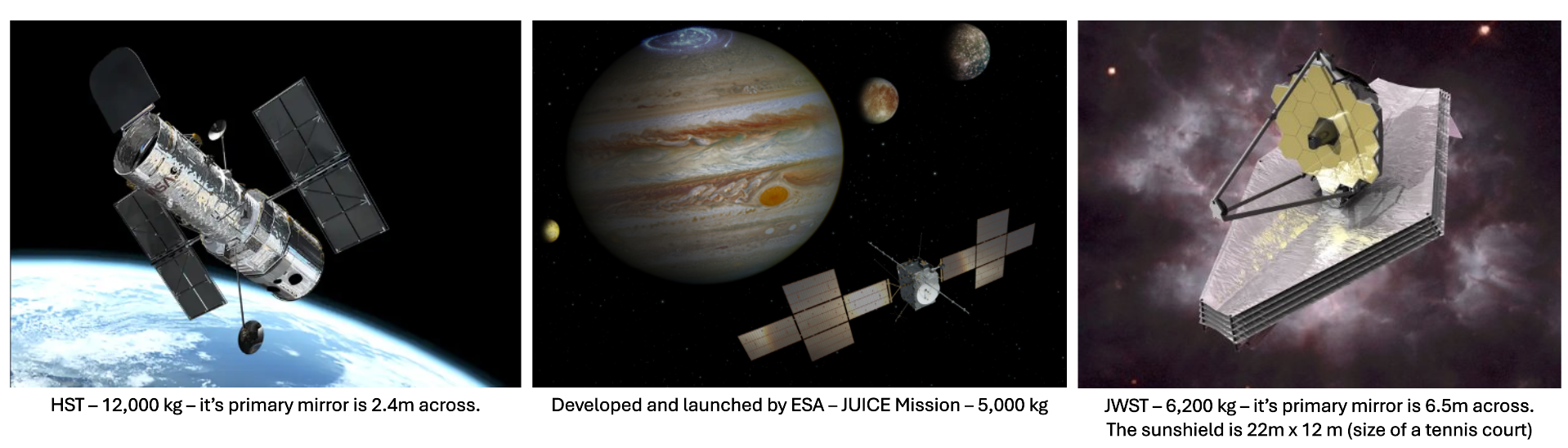
Large satellites (more than 1,000 kgs)
Large satellites are similar to the size of a bus and weigh more than 1,000 kg. The majority of these are found in GEO. Their applications include interplanetary missions, space observatories, telecommunication, earth observation and weather satellites.
Heaviest telecommunication satellite ever launched is Telstar 19V, that weighs 7,076 kg!
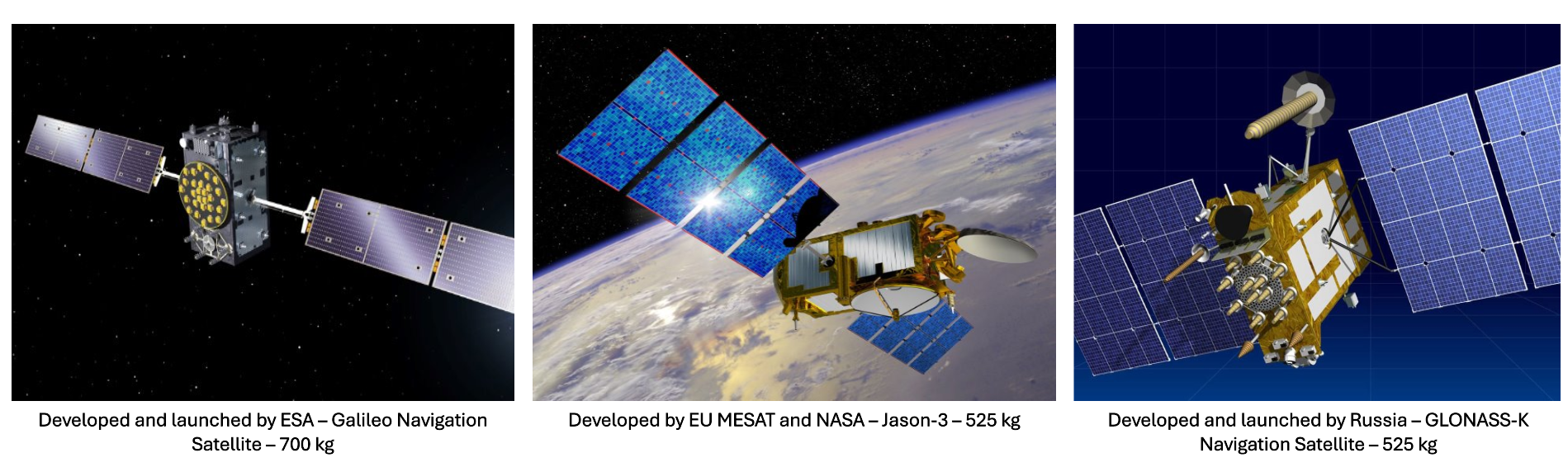
Medium satellites (500–1,000 kgs)
Medium satellites weigh 500 – 1,000 kg and are found in all orbits ranging from LEO to GEO. They are mostly applicable in navigation, telecommunication, weather and Earth observation.
Small satellites (0,1–500 kgs)
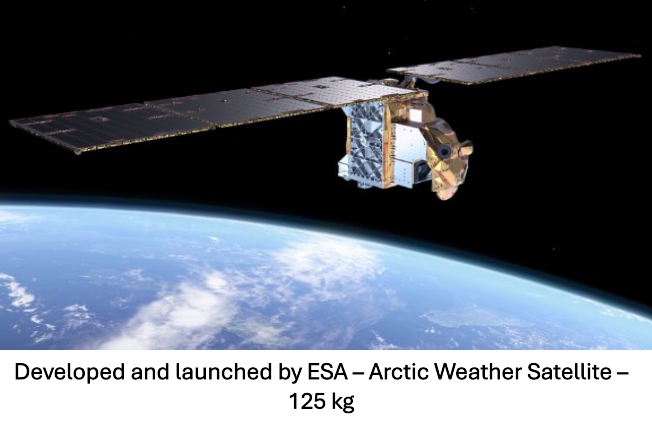
Mini
These weigh 100 – 500 kg. They are commonly launched in LEO and are used in applications such as telecommunication, Earth observation and technology development.
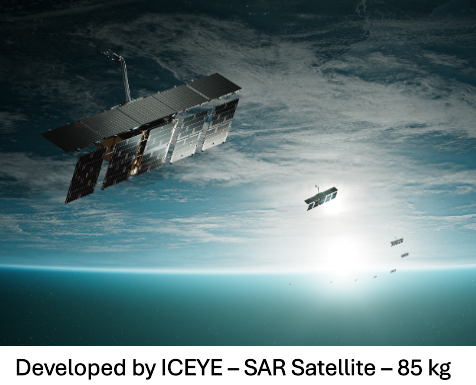
Micro
These weigh 10 – 100 kg. These also include a portion of the popular CubeSat* satellites (6U and 12U variants). They mostly operate in LEO positions.
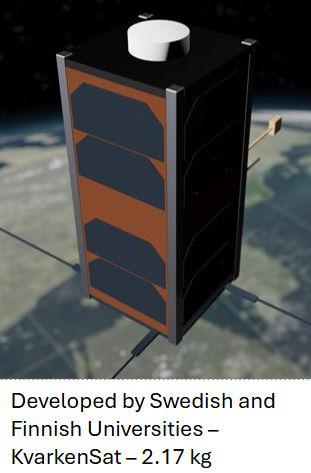
Nano
These weigh 1–10 kg. A major portion of CubeSats also falls within this category.
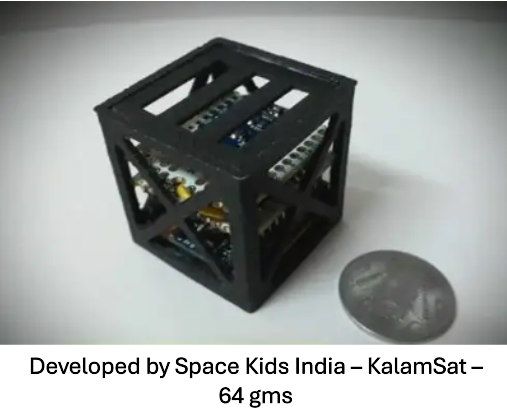
Pico
These weigh 0.1–1 kg. They typically involve multiple satellites working together in formation or as a ’swarm’. Some designs also include a ”mother” satellite for communication with ground stations or for launching and docking picosatellites. The payloads are approximately the size of a soda can.